Why 2026 Interiors Are Moving Away From Straight Lines


There is something almost biological about what is happening in interior design right now. After nearly a decade of sharp corners, grid-based layouts, and the rigid geometry of modern minimalism, homes in 2026 are softening. Visibly, deliberately, and with great intention. The straight line, that symbol of industrial precision and cool rationality, is quietly losing its grip on the spaces where we actually live.
This is not a passing aesthetic whim. It is a response to how people feel inside their homes, and increasingly, research is backing that feeling up.
The Psychology Behind the Curve
Neuroscientists and environmental psychologists have long studied how architectural shapes affect human mood. A landmark study published in the Proceedings of the National Academy of Sciences found that people consistently rate rooms with curved furniture and rounded architectural features as more inviting and less threatening than rooms dominated by angular forms. The researchers linked this to an evolutionary response, where sharp edges signal potential danger and soft curves signal safety.
That science is now filtering into mainstream design conversation. In 2026, when people say they want their home to feel like a sanctuary, they are increasingly making choices that reflect exactly this neurological preference, whether they know the research or not.
The 2026 Elle Decor Design Forecast identified organic forms as the defining shift of the year, noting that arches, rounded furniture profiles, and soft sculptural shapes are replacing the right-angle rigidity that defined the previous decade of interior aesthetics. This is not a regional trend. It is global.
Where the Straight Line Came From and Why It Stayed So Long
To understand why we are moving away from something, it helps to understand how deeply embedded it became. The dominance of straight lines in interior design has roots in modernism, the early 20th century movement that rejected ornament in favor of function, industrial materials, and geometric purity. Bauhaus principles, Le Corbusier's machine-for-living philosophy, Scandinavian functional minimalism, all of these pushed architecture and furniture design toward the rectilinear.
For decades, this worked beautifully. Clean lines photographed well, scaled easily to mass production, and felt appropriately serious in a world that equated simplicity with sophistication. Then social media amplified those qualities to an extreme. The perfectly gridded shelfie, the all-white kitchen with handleless cabinetry, the modular sofa with ninety-degree corners. Homes began to feel like they were designed for content creation rather than actual human comfort.
By the early 2020s, the backlash was already beginning. By 2026, it has fully arrived.
Organic Forms Are Everywhere Now
Walk through any leading furniture showroom today and the shift is undeniable. Sofas have rounded arms and gentle kidney shapes. Mirrors are no longer rectangular. Headboards billow upward in soft arched silhouettes. Tables abandon their rectangular templates in favor of shapes borrowed from nature, from stones, from pooled water, from the unhurried edge of a petal.
The oval pedestal coffee table is one of the clearest expressions of this movement. It has become a cornerstone piece in 2026 living rooms precisely because it solves a design problem that angular tables never quite could. An oval table has no corners to navigate around, no sharp edges at shin height, no rigid geometry that refuses to integrate with the organic softness of a curved sofa or an arched doorway. It sits in a room the way a smooth stone sits on a riverbank, with complete, effortless belonging.
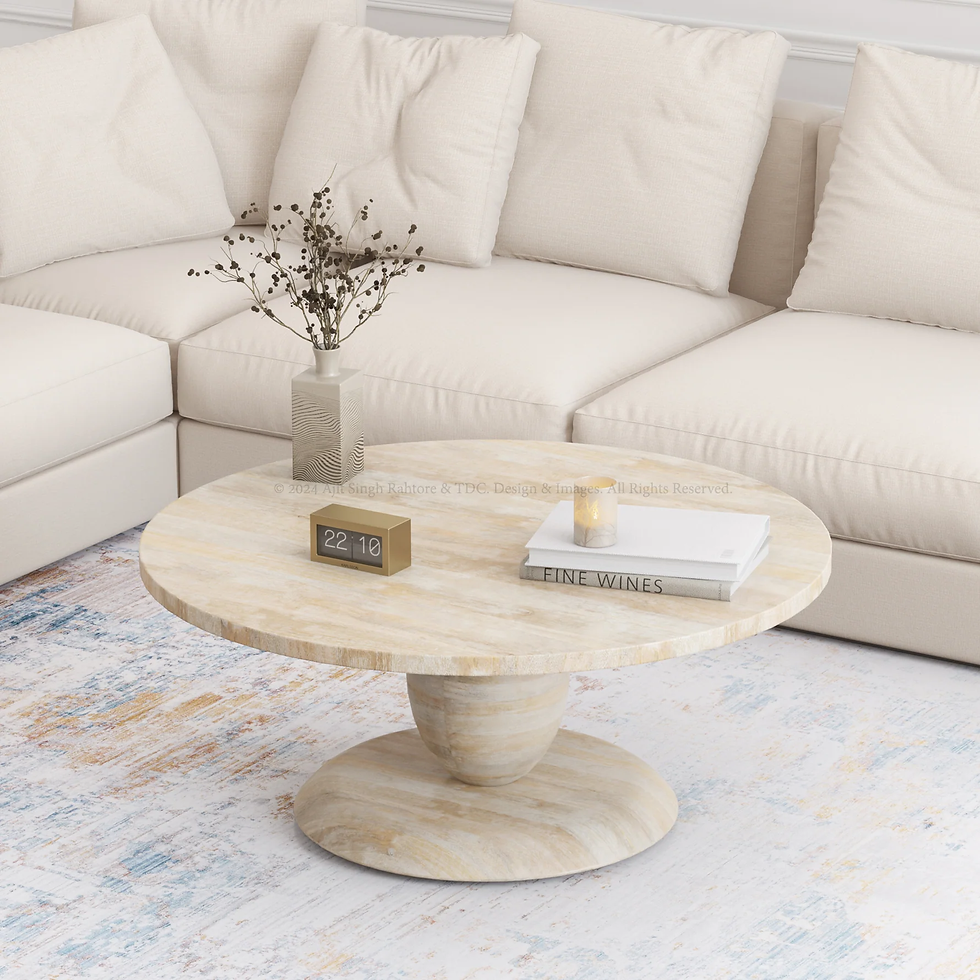
Interior architect Ilse Crawford, whose work is extensively covered by Dezeen, has argued for years that furniture should be judged by how it makes the body feel, not just the eye. The oval pedestal coffee table passes that test intuitively. Its shape invites people to move around it, gather near it, reach across it without obstruction. Function and form united in a single gentle curve.
The Return of the Handmade and the Irregular
Alongside the preference for curves comes something equally important: a renewed appetite for imperfection. The machine-perfect straight line is also, by its nature, a cold one. It carries no evidence of human hands. In 2026, the most coveted interiors are ones that feel inhabited, crafted, and slightly irregular in the best possible sense.
This is driving strong demand for handcrafted furniture, and nothing captures this appetite quite like the rustic dining set. A well-made rustic dining set brings natural wood grain, honest joinery, and the gentle irregularities of real craft into the heart of the home. It does not pretend to be flawless. It tells a story with every knot in the timber and every hand-finished edge. Placed in a room with curved walls, arched doorways, and organic textiles, it creates the kind of warmth that no amount of perfectly machined furniture ever could.
Apartment Therapy's 2026 design survey found that searches for handcrafted and artisan furniture have increased by over 40 percent year on year, a number that reflects a deep cultural hunger for authenticity in a world drowning in manufactured precision.
At The Rural Art, this philosophy runs through every piece in the collection. The commitment to natural materials and honest craft positions the brand squarely at the intersection of where design is heading, toward warmth, toward texture, toward the enduring beauty of things made with care.
Arches, Niches, and the Architecture of Softness
The curve movement is not limited to furniture either. Architects and interior designers are reshaping the rooms themselves. Arched doorways are replacing square-framed openings. Niched shelving with rounded tops is being built into walls. Ceilings are getting curved plaster detailing borrowed from Mediterranean and Moroccan architecture.
Publications like Architectural Digest and House & Garden have both noted the influence of Wabi-Sabi, the Japanese philosophy of finding beauty in imperfection and incompleteness, on Western interior design this year. Wabi-Sabi has no patience for the rigid right angle. It finds poetry in the worn edge, the organic contour, the shape that nature, not a machine, would produce.
What This Means for How We Design Going Forward
The move away from straight lines is ultimately a move toward humanity. It says that a home should feel like a body lives there, not a concept. It recognizes that the people who occupy spaces are soft, curved, and irregular, and that the objects surrounding them should respond to that reality rather than ignore it.
If you are rethinking a room in 2026, the question to ask is not whether something looks clean on a grid. The question is whether it feels right when you are actually inside it. More often than not, the answer will involve a curve.
Comments